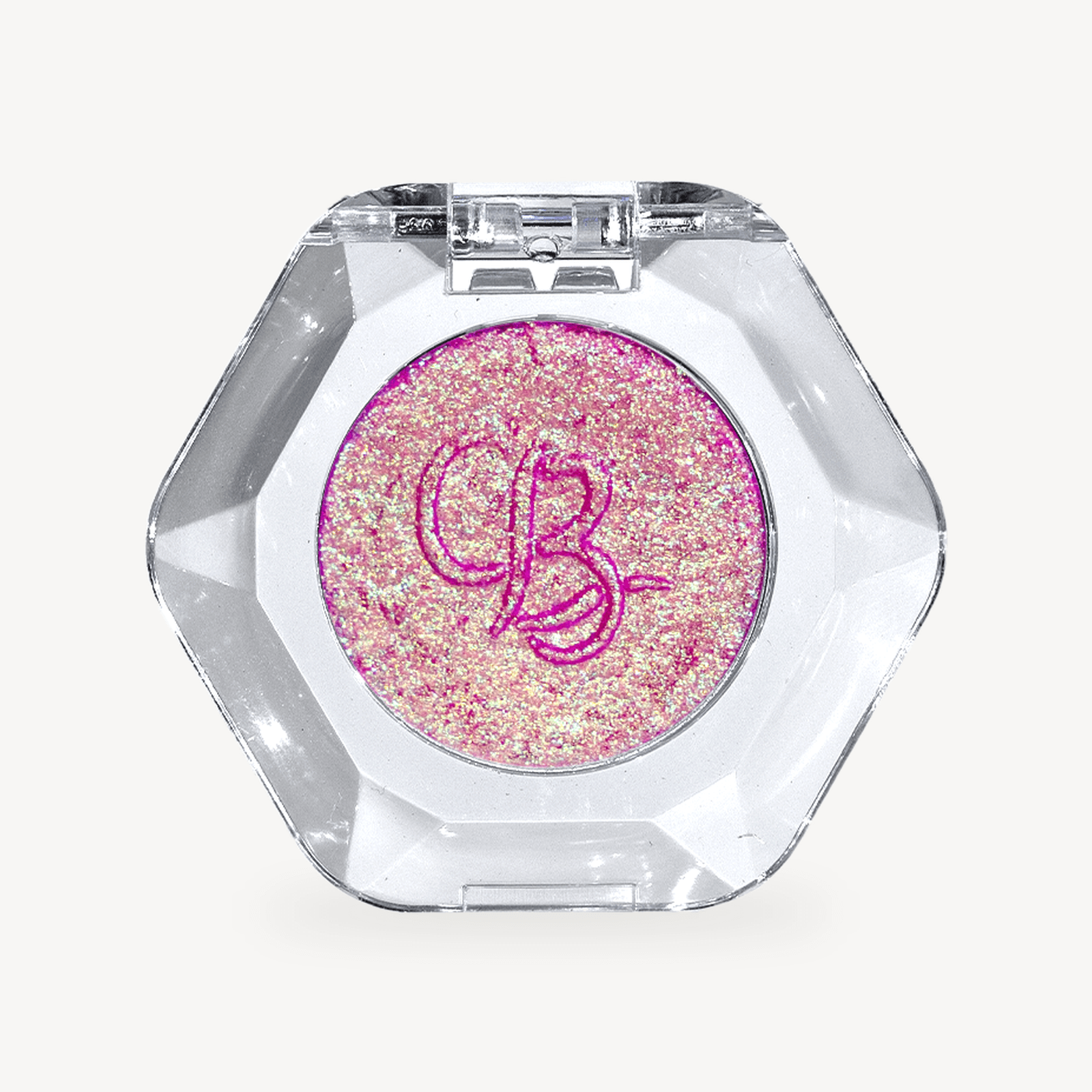

If you've never used multichrome makeup before, it can be a little confusing at first.
You look at the pan and see one color. Then you tilt it toward the light, and suddenly there's another color hiding underneath. On the eye, it can look different again.
That's not a trick or a filter.
That's the point of multichrome.
A multichrome eyeshadow is designed to show different color reflections depending on the angle and lighting. Some shifts are subtle. Others can move through several noticeably different colors.
If you're new to this kind of makeup, this guide will walk you through what multichrome actually is, how it differs from duochrome, why the color changes, how to apply it, and what to expect on different skin tones.
What Is Multichrome Makeup?
The simplest way to understand multichrome is to think about one shade with more than one visible color.
A regular eyeshadow usually has a main color that stays fairly consistent. A shimmer can catch the light and look brighter or more metallic, but you can still recognize its basic color.
Multichrome is different.
Depending on how the light hits the pigment and how you look at it, you may see several different colors from the same eyeshadow.
For example:
pink → purple → blue → green
or:
gold → green → turquoise
The exact shift depends on the shade. Not every multichrome shows the same number of colors, and not every color will appear equally strongly.
That's also why multichrome is hard to describe with just one color name.
Take OURBELLA's Aphrodite, for example. On the product page, the shade is described as moving through vivid pink, icy blue, mint green and touches of gold as the light and viewing angle change.
So if someone asks, “Is Aphrodite pink or blue?”
The honest answer is: It depends on what angle you're looking at it from.

Why it looks different in person
This is one reason photos don't always tell the whole story.
A photograph captures one angle under one lighting setup. When you're wearing multichrome eyeshadow, you're moving your face, blinking, turning your head and walking through different light sources.
So the color is constantly giving you slightly different reflections.
The movement is part of the effect.
Multichrome vs. Duochrome: What's the Difference?
If you've heard the term duochrome before, you may be wondering how it differs from multichrome.
The basic idea is pretty simple.
A duochrome usually has a more obvious shift between two main colors.
A multichrome can show a broader range of color as the viewing angle changes.
|
|
Duochrome |
Multichrome |
|
Color shift |
Usually two main colors |
Multiple color reflections |
|
Overall effect |
Two-tone |
More dimensional |
|
Example |
Purple → Green |
Pink → Purple → Blue → Green |
|
Feel |
Easier to keep subtle |
More noticeable and changeable |
Neither is necessarily “better.”
If you like a simple color contrast, duochrome can be a great place to start.
If you like makeup that looks different when you move, multichrome gives you more of that effect.
And there can be some overlap. The terms aren't always used in exactly the same way by every makeup brand, so it's better to look at the actual swatches rather than relying on the name alone.
Why Does Multichrome Makeup Change Color?
This is the part that sounds complicated, but the basic idea isn't too hard.
Light is the reason you see the shift.
Many color-shifting cosmetic pigments use reflective structures that interact with light differently depending on the angle. Interference pigments, for example, can use thin layers of materials to create different reflected colors.
You don't need to understand the chemistry to use the makeup, though.
Think about it like this:
Light hits the pigment → the pigment reflects light → you see a particular color.
Change the angle:
the reflected light changes → the color you notice changes.
That's why you can look straight into a mirror and see one color, then turn your head slightly and suddenly notice another.
Four things affect what you see
1. The pigment — Different pigments create different shifts.
2. The lighting — Natural daylight, direct light and indoor lighting can make the same shade look different.
3. The viewing angle — This is one of the biggest parts of the multichrome effect.
4. The base underneath — Your eyelid, primer or another eyeshadow underneath can affect the final appearance.
OURBELLA also notes on its product pages that lighting, viewing angle, skin tone, eye base and application can all affect how a color-shifting shade looks.
So when you see a multichrome shade look different in two photos, that doesn't automatically mean one of the photos is inaccurate.
You may simply be seeing a different part of the shift.

How to Apply Multichrome Eyeshadow
Here's the good news: You don't need a complicated technique.
If you're trying multichrome for the first time, start with one shade.
Step 1: Start with a clean lid
Begin with clean, dry eyelids.
If you normally use an eyeshadow primer or eye base, you can apply it first.
You don't have to use a black base just because you're using a multichrome.
Step 2: Pick up a small amount
Use your fingertip or a flat eyeshadow brush.
Start with a little product.
Multichrome doesn't need to be packed on heavily right away.
OURBELLA's current application instructions recommend using a clean fingertip or flat brush and starting with a small amount.
Step 3: Press it onto the lid
This is where I'd change the way you approach it if you're used to regular eyeshadow.
Instead of immediately sweeping the product back and forth, press it onto the lid.
You can soften the edges afterward.
Pressing helps keep the reflective effect concentrated on the area where you want it.
Step 4: Build slowly
Look at the first layer before adding more.
Want more color? Add another thin layer.
Want something softer? Stop after the first layer.
OURBELLA recommends gradually adding another light layer where more reflective color is wanted.
Step 5: Change the lighting
Now look at your makeup from different angles.
• facing a window
• standing under indoor lighting
• looking toward a direct light
• turning your head slightly from side to side
You'll often notice colors that weren't obvious when you first applied the shadow.
That's when multichrome gets interesting.

How to Make Multichrome Eyeshadow More Vibrant
If you want the color shift to stand out more, there are a few things worth trying.
Don't start with too much product
It sounds backwards, but starting with a small amount gives you more control.
You can build the color.
Try pressing instead of blending
Blending is useful around the edges, but excessive blending can soften the reflective effect.
For stronger impact, press the product where you want the most color.
Experiment with your base
Try the same shade over:
• bare skin
• a neutral base
• a darker base
• a complementary eyeshadow
You may be surprised by how much the base changes the overall look.
But there isn't one base that will automatically make every multichrome look better.
Experimenting is part of figuring out the shade.
And don't forget the light
If you think a shade isn't shifting much, change the lighting before adding more product.
Sometimes the pigment isn't the problem.
You're just looking at it from the wrong angle.
How Does Multichrome Look on Different Skin Tones?
One of the biggest mistakes you can make when shopping for multichrome makeup is assuming that the shade will look exactly like the product photo on your own skin.
It probably won't.
And that's normal.
The same eyeshadow can look different depending on skin tone, undertone, base and lighting.
Fair Skin
Lighter skin can create more contrast with bright reflective pigments.
Soft pinks, icy blues, lavender and pale green shifts may look particularly noticeable.
Medium Skin
On medium skin, warmer reflections such as gold, peach and bronze can become more prominent, while cooler shifts can create stronger contrast.
Deep Skin
On deeper skin tones, brighter reflective colors can create a beautiful contrast, especially when the light catches the pigment.
But don't take this as a strict rule.
A shade isn't “for” one skin tone.
The best way to judge it is to look at swatches on skin that is close to yours, preferably in more than one type of lighting.
And remember that the eye base underneath can change the result too.
Same shade. Different skin. Different light.

That's why we recommend treating online swatches as a reference rather than an exact prediction.
Multichrome Makeup Looks to Try
You don't need a huge palette to start experimenting.
One shade is enough.
Start with one color
Apply one multichrome over the lid and keep everything else simple.
This is probably the easiest way to understand how the color shift works.
Try: Aphrodite
Aphrodite shifts through vivid pink, icy blue, mint green and touches of gold.
Want something softer?
Try: Dreamy
Dreamy moves through pink, lilac, peach and warm gold.
Prefer cooler colors?
Try: Mirage
Mirage shifts through aqua blue, turquoise, icy cyan and soft violet.
Want something more pastel?
Try: Prism
Prism is built around lavender, icy blue, pale green and soft pink tones.

And if choosing one shade feels impossible, OURBELLA's Full Spectrum 21-Piece brings together warm and cool shades, including pink, coral, gold, orange, red, green, turquoise, blue, lilac, violet and silver. The set can be used one shade at a time or combined into gradients and contrasting looks
Multichrome Isn't Just for Eyes
Once you start noticing color-shifting makeup, you'll see that the idea isn't limited to eyeshadow.
Lip products can use shimmer and reflective finishes to create a similarly dimensional effect.
For example, a color-shifting or highly reflective lip gloss can look different depending on the light hitting the lips and the color underneath.
OURBELLA's Shimmer Lip Gloss collection currently includes shades such as Midnight, Unicorn, Ice Lava, Fairydust, Bonfire and more
The same basic idea applies:
light hits the reflective particles → the reflection changes → you notice different colors.
So if you like multichrome eyeshadow because it never looks exactly the same twice, a dimensional lip gloss can bring a similar idea to the rest of your makeup.
The Easiest Way to Start With Multichrome
If all of this sounds like a lot, don't worry.
You don't need to know the chemistry.
You don't need five different brushes.
And you definitely don't need a complicated eye look.
Start with one shade.
Put a small amount on your lid.
Press it on.
Look at it in natural light.
Then turn your head.
That's probably the simplest way to understand why people get so hooked on multichrome makeup.
The shade isn't really changing.
You're seeing something different from the same shade.
And once you notice that first shift — pink becoming purple, blue revealing green, gold catching red — regular eyeshadow can suddenly feel a little less interesting.
FAQ
What is multichrome makeup?
Multichrome makeup is makeup designed to show multiple color reflections depending on lighting and viewing angle.
What is the difference between duochrome and multichrome?
Duochrome usually focuses on a shift between two main colors, while multichrome can reveal several color reflections as the angle changes.
Does multichrome eyeshadow need primer?
No. Primer isn't mandatory, but it can provide a more even base and can affect how the final color appears.
Do I need a black base for multichrome eyeshadow?
No. A black base can change the appearance of some shades, but it isn't required for multichrome eyeshadow.
Try the shade over different bases and see which version you prefer.
Why does multichrome makeup look different in photos?
Because a photo captures one angle under one lighting setup. Multichrome effects are meant to be viewed as light and angle change.
How do you apply multichrome eyeshadow?
Start with a clean, dry lid. Apply an eye base if you normally use one, pick up a small amount of product, press it onto the lid, softly blend the edges and build the intensity gradually.
Does multichrome makeup work on all skin tones?
Yes. The same shade may look different across skin tones, though. Skin tone, undertone, base, lighting and application can all affect the final appearance.
See the Color From Every Angle
Multichrome makeup is easier to understand once you stop trying to describe it with just one color.
Sometimes it's pink.
Sometimes it's blue.
Sometimes you catch a little green or gold that wasn't there a second ago.
That's the fun of it.